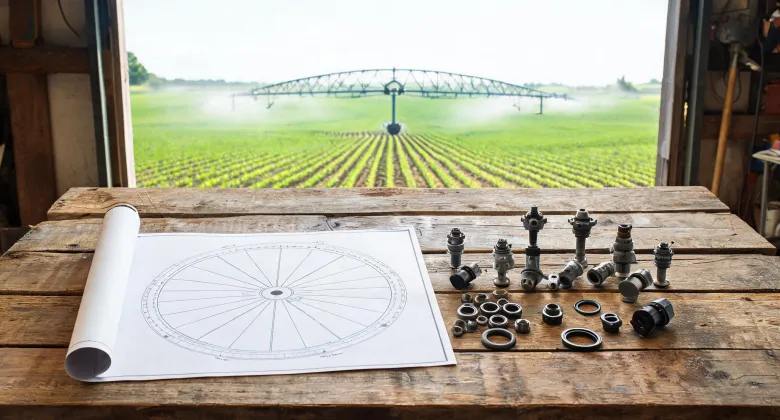
Field shape, not span count, decides how much of a center pivot's circle lands on your crop and how much of your ground stays dry. Round and square fields sit almost entirely under the circle, and that is the exception; on a field that is neither, the ground outside the circle stays unirrigated unless you add reach at the outer end or buy a part-circle machine.
So the corner decision belongs at the front of the quote, not at the bottom as an add-on line. Corner hardware changes how many of your planted acres get water, and a dealer who prices the spans before the corner is settled is pricing the wrong machine.
Where the Circle Leaves Your Field Dry
A center pivot is a self-propelled machine that rotates around a central pivot point, and the area it wets is a circle with that point at the middle. Because the wetted shape is circular, it is best adapted to ground that is round or square. Extension material from Georgia reports that most fields there are neither. The uncovered strip is not a commissioning fault or a plugged nozzle; it is the gap between the circle's outer edge and your planted boundary, and it will be there on every pass for the life of the machine.
That geometry sets the first buying question. Establish where the circle's edge falls relative to the ground you farm, and where the fixed obstacles sit: the farmstead, the road, the fence corner, the drainage ditch that cuts a diagonal across a quarter. If the ground outside the circle is pasture or building site, a dry corner costs you nothing and the cheapest full circle is the right buy. If that ground carries the same cash crop as the center, you are deciding how much production to hand over, and that decision has to be in the quote before the spans get priced.
Count the Acres You Will Actually Water
Coverage is circular, so the acreage that matters in a bid is the overlap between the circle and your planted area, not the acres printed on a spec sheet. Extension guidance on pivot selection notes that a formula exists for computing the acres a pivot covers. Work that figure against your own boundary before you talk to anybody, because every bid you collect afterward hangs off it.
I pull the field boundary drawing, overlay the circle, and shade everything the circle misses. Two numbers fall out, circle acres and planted acres, and the difference between them is the ground you are actually arguing about. Then every dealer quotes against the irrigated-acre figure instead of the machine footprint. Same span count on both bids, and now they line up, because you are comparing what you actually pay for each watered acre rather than the price of a run of galvanized pipe.
Get this step out of order and the error hides. A quote written on machine footprint looks cheaper than an identical machine quoted on watered acres, so the low bid wins on a technicality and you find out at the first dry July which bidder counted the corners. That is why the marked drawing stays in front of me through the whole comparison instead of going in a folder after the first meeting.
When a Part-Circle Machine Earns Its Cost
On irregular ground, part-circle machines exist for a reason: they are built to irrigate as much of the field as possible where a full circle would swing across ground it cannot use. The trade is stated plainly in the extension material, because these systems generally cost more on a per-acre basis since they cannot complete a full circle. You are paying a premium for hardware that spends part of every rotation doing less than a full sweep.
Suppose the corners grow the same irrigated crop as the middle. Then that per-acre premium is being weighed against the value of the corner production it recovers, and a part-circle layout can make financial sense. Suppose instead the land outside the circle is a farmstead, a road shoulder, or ground you would dryland anyway. The same premium buys almost nothing, and a full circle that ignores that ground is the better purchase.
That is a judgment about your field and your cropping plan, not about which machine class is superior. Settle it before you collect quotes, because the answer decides which product you are shopping for and which dealers are even relevant.
End Gun First, Corner Arm Second
Two add-ons do most of the corner work, and they are not the same purchase. An end gun is a large-volume sprinkler mounted at the outer end of the system; it can be turned on and off as the machine moves around the field, and it allows the system to water an additional 100 to 150 ft in corners and other irregular parts of the field. A corner pivot option is different hardware: an extra span at the end of the machine that swings out and waters an additional 300 to 400 ft in the corners.
Price the end gun first. It buys that first reach with a sprinkler you switch on and off, and because it is not a span, it adds no drive unit and no set of joints to keep aligned. Add the swing-out corner span second, and only where the second reach lands on ground worth more than the hardware and the maintenance it brings with it.
Order matters because both show up as line items and the corner span is the expensive one. If a dealer leads with the corner arm and never puts the end-gun number in front of you, you cannot see how much of the corner problem a switchable sprinkler would have handled. Ask for both prices, and ask where the wetted edge lands with each one on your drawing.
What I Check Standing in That Corner
I walked the two worst corners of a quarter before signing anything, map in hand, and what I saw there was not in the spec sheet. I noticed the pivot track sitting closer to the fence on the west side than on the east, which put the dry sliver in a different place at each end of the same field. I checked where the wetted edge met the crop row and found the stand thinning along that line rather than scattered through the corner the way a fertility problem looks. Late in the season I saw the same edge hold after the last set, sharp enough that I could have stepped it off.
None of that is a measurement. I did not pull soil samples, shoot grades, or read flow; I looked at where the crop stopped and where the machine's reach stopped, and the two lines agreed. What the walk gave me was a question with a location attached: here is the corner, here is what stays dry, show me what your add-on does to this spot. Standing in the corner with the person selling the hardware is worth more than any conversation over a brochure at the office. Do it before the order is written, not after the first rotation.
Match Rotation Time to Your Well
Rotation time is the constraint that decides how much machine your water supply can carry. The drive can run on water pressure, hydraulic oil, or electric motors, and most systems in use today are electric drive. How long a rotation takes depends on system size, the capacity of your pump or well, and how much water is applied per pass, and it can run from hours to days.
The improvement is to size the span count and the corner hardware against the rotation time your well can actually support, before the layout is locked in. Reach into a corner is worth little if using it stretches a pass past what the pump and well can keep up with, because then you own hardware sitting in a field it cannot finish on schedule. That is how a corner decision turns into a whole-field problem.
Ask the dealer to state the rotation time the proposed machine implies on your water supply, and to say which span count that time is built on. If the answer comes back as a range with nothing behind it, you have not learned what the machine will do on your well. Soil, terrain, and flow data for your field are the missing pieces here, and no published guide substitutes for them.
The Trade You Make Before Signing
Corner coverage trades money for watered acres, and the trade is worth writing down before you sign. What you gain is watered acres in the corners and irregular pieces, through a part-circle layout, an end gun, or a swing-out span. What you give up is the lowest machine cost per acre, the simplest machine available, and the shortest list of parts that can stop a pass, because a switchable gun and a swinging span both add hardware that has to keep working in a week you needed the pivot moving.
So put three questions in front of whoever is quoting. Which acres of my field does this quote actually water? What does the machine cost on the acres it actually covers? And what is still missing from the design, soil, terrain, flow, that would change the answer? Nothing in a published selection guide settles wetted width, pressure, or application depth for your ground; only your field data does, so treat coverage numbers as design assumptions until they are in the quote. Buy the corners you can afford to pay for twice: once at signing, once at every repair.

Leave a project-related comment