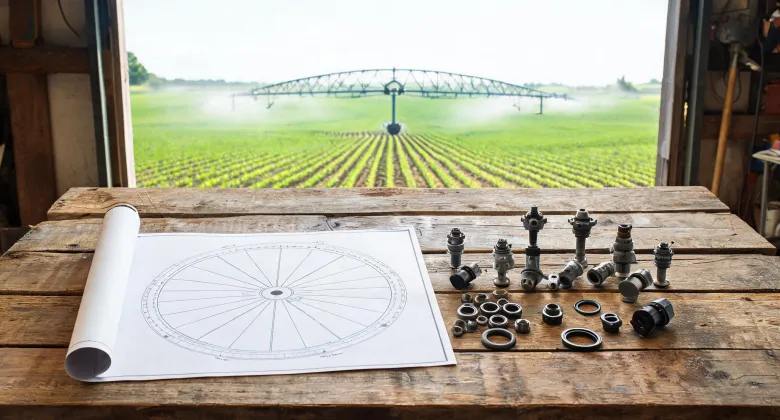
A grower stands at the pivot control panel with a clipboard of run times in one hand and a soil probe over his shoulder, asking the question that comes up in a dry stretch of July: should I slow this machine down? He has corn at tassel, a pivot that ran fine last season, and a hunch that a slower pass will fix the dry strip on the west side. Slowing the machine is the easy change to make, and the first one tried.
Check flow and crop peak demand first. Move the travel speed after that. Flow rate is the ceiling on what the machine can put out; travel speed only converts that flow into depth per pass and into rotation time. A pivot whose flow-to-acreage match is wrong cannot be rescued by the timer alone, no matter how slowly it crawls. What speed genuinely controls is how the water you already have is spread across the field and how many days a full circle takes — two things worth setting carefully, but only once the capacity question has an answer.
Flow Sets the Ceiling, Not the Speed Dial
The depth of water a pivot applies in a given pass comes from two numbers: the speed at which the system moves around the field and the system flow rate. Travel speed is the operator's choice, and the target depth is what tells him where to set it. With flow held constant, more acre-inches of water across the field means a longer rotation, because the machine has to take more time to leave more water behind the last tower. Set it faster and the same flow is spread thinner. Set it slower and the same flow piles up deeper.
I keep the relationship in my head as two separate quantities. Flow is how many gallons per minute arrive at the pivot point. Travel speed sets how long the machine spends over each acre, and that time is what turns a fixed flow into depth. Change the speed and the depth changes, and the rotation time moves with it. That distinction is why a slow setting can feel like a fix while the crop keeps running short.
The field that never quite keeps up is the one this bites. It shows up looking like a speed problem — a dry corner, a crop that flags between passes, a wettest spot right where the towers stop — and the first thing tried is a slower setting. Sometimes that is correct. Other times the machine is already near its capacity, and a slower pass only stretches the rotation. The field can look better watered on the day you walk it and still leave the crop short before the next visit.
Travel Speed Is the Wrong First Lever
If I had to spend the first part of a service visit on one thing, I would spend it on measured flow and the crop's peak water use, and I would leave the speed timer alone until both are written down. That preference comes from where the slack actually sits, not from any dislike of the timer. A speed change moves water around inside the capacity the machine already has. The timer is a good tool for hitting a depth the system can already deliver, and a poor tool for covering a shortfall.
Before touching the setting, I want four answers. How many gallons per minute the pivot really delivers, checked at the pump and out at the far end rather than read off a nameplate. What peak daily water use looks like for the crop standing in that field this week, at its current stage. How long a full circle actually takes at the setting now in the controller. And whether the field is being watered in one long pass or split into several smaller events. Those four answers decide whether speed is even the right conversation to be having.
The preference holds only while measured flow covers peak demand. Once the flow number is short of what the crop needs, the hour belongs to the pump, the nozzle package, or the acres under that machine, and the sequencing flips. That is the condition I would put on my own advice, and I would rather state it plainly than pretend the timer can do work it cannot.
A Two-Block Test I Would Run
Suppose I had a pivot running over two comparable blocks — same soil map unit, same crop, same planting date, both fed by the same machine. I would not take anyone's word, including mine, for what a speed change actually does. I would run the comparison for a single rotation and write down what came back, because the arithmetic is easy to state and surprisingly easy to get wrong once a field is in front of you.
The setup is plain. I would hold the pivot flow where it is, note the pump rate and the pressure at the pivot point, and set one block to a slower travel speed than the other. Then I would record, for both blocks, the speed setting, the start and stop time of each pass, the depth caught in a line of rain gauges or catch cans under the spans, what the soil surface looked like behind the last tower, and the crop stage on the day of the pass. Nothing exotic, and nothing I could not do with a notebook and a morning.
Comparing the slower block with the faster one would tell me what the speed change bought: more depth per pass and a longer rotation, in roughly the proportion the flow relationship predicts. Comparing rotation time against the crop's weekly demand would tell me whether the slower setting still fits inside the interval the crop can tolerate. Unlike a timer-only check, where I read a percentage off the controller and assume the depth that follows, the catch cans would give me the number the field actually received — and those two numbers are not always the same.
The result I would accept is narrow. If the slower pass puts down the depth the crop needs at peak demand, the soil takes it without ponding or running off the low end, and the longer rotation still suits the crop's stage, then the setting is defensible and I would leave it. If any one of those three fails, the answer is not a different speed. It is a different flow, a different sprinkler package, or fewer acres under that machine. That is the honest version of the test, and I would run it as a comparison rather than as a search for a setting I already wanted to find.
Crop Demand Moves the Target Every Week
Even a well-matched pivot chases a target that moves. Irrigation demand depends on crop species and variety, canopy size, plant population, rooting depth, and stage of growth, and all of those drive transpiration, light interception, and how fast the soil surface dries. A mature canopy uses more water than a field that has not closed over yet. A recently transplanted crop draws from a much thinner slice of soil than a mature stand with roots down through the profile, which is why the same setting can be generous in June and stingy in July.
The peak number matters more than the seasonal average, because the machine has to keep up on the worst week. UGA Extension's Georgia example puts corn peak use near 0.34 inch per day, about 2.38 inches a week, and notes that growers there often split that weekly amount across two or three events to stay under the soil's intake rate, which works out to roughly 0.79 inch per pass. Those are Georgia figures for Georgia corn. They are a worked example of the method, not a national target to type into a controller in Nebraska or the Columbia Basin.
The practical consequence is that the speed setting which fit last month's canopy may be wrong this month, and nothing has to be broken for that to happen. With flow unchanged, a fixed percentage on the timer is a fixed depth per pass. The demand side is not fixed at all. An operator who sets the machine once in June and leaves it can overwater an immature canopy early and underserve a full one at tassel, and the field will show it in the places where the pattern overlaps before it shows anywhere else.
The Check That Would Change My Mind
Before I trusted anyone's recommended setting, including my own, I would compare the measured flow at the pivot against the crop's peak demand for the acres the machine covers, and compare the rotation time at the chosen speed against the interval that crop and that soil can live with. Then I would walk behind the last tower and look for ponding, for water running off at the low end, and for a dry strip where the pattern overlaps. Those three observations take a walk and can settle more arguments than any specification sheet.
Any of three findings flips my conclusion. If flow cannot cover peak demand at any setting, slowing down only spreads the shortfall over more hours. If water ponds or runs off before the target depth is in the profile, the limit is the soil's intake rate, and the response is smaller, more frequent events rather than a slower machine. If the field's soil, terrain, or crop sits well outside the conditions those Georgia and Utah examples describe, the numbers stop transferring and a local check should replace them.
We do not have soil, terrain, and flow measurements for your particular field here, so I am not going to issue a nozzle package, a pressure, or a depth per pass from a desk. Anyone who does that without your numbers may be guessing at your ground and dressing the guess up as a specification.
This is not for the operator who wants one number to type in and forget, or who hopes to fix a short water supply by turning the timer down. It fits the grower who will pull the flow figure, the current crop stage, and the last rotation time before touching the speed setting. Write those three numbers down before the next pass starts. The setting follows from them, not the other way around.

Leave a project-related comment