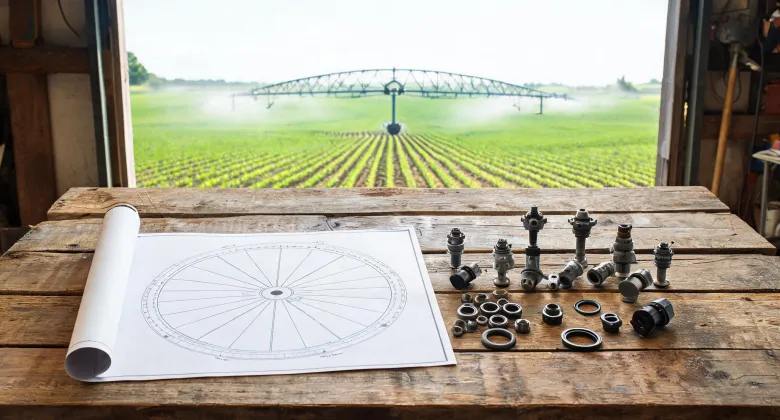
Can one towable pivot cover my small, irregular fields without turning into a labor trap? Yes, provided the crew time to move the machine and the planting and furrow work LEPA needs are budgeted as part of the system rather than treated as details. Price the iron alone and the towable option looks cheap. Add the moving and the geometry and the comparison gets honest.
Strip away the attachments and it is still a center pivot: a machine that waters a circle around a pivot point. Two things change when the machine is towable and the sprinkler package is LEPA: where the water lands, and where the machine has to be next week. Neither change shows up clearly on a dealer's quote.
What Makes a Pivot Towable
What is a towable center pivot, and how is it different from the fixed pivot most growers picture? On some systems, provisions let the drive wheels rotate 90 degrees so the whole machine can be moved from one pivot point to another. That single feature is the definition. The sprinkler package on top is a separate decision, so a towable pivot is not automatically a low-pressure machine, and a low-pressure machine is not automatically towable.
Where it gets used tells you the intent. Towable pivots have proven useful on small, irregular-shaped fields, and they are most common on small adjoining fields, usually 75 acres or fewer. Shape and adjacency matter more than the acreage itself, because the machine has to fit and the next field has to be close enough that the trip is worth making.
The Real Cost Is Moving the Machine
The advantage is easy to state: one system serving more than one field reduces the initial investment per acre. The disadvantage is just as real and easier to underestimate, which is the labor required to move the system. Both come off the same page of extension guidance, and buyers tend to remember the first and forget the second.
So the question shifts. It is no longer whether a towable pivot costs less than two fixed machines. It is whether your farm has people available at each move, and whether the land you gain by sharing one machine is worth a recurring job that returns every time the water has to shift fields. A machine that saves capital and then sits because nobody has the afternoon free has saved nothing.
If moving is the cost, what field layout makes it tolerable? That one is answered on a map, not in a brochure.
Screen Your Fields Before You Shop
Which conditions should be checked before anyone prices a machine? Start with the parcel map. Mark the shapes, mark which fields touch each other, and confirm the machine would actually serve more than one of them. A towable pivot that ends up on a single field has paid for hardware it never uses. On the same sheet, write down who is available to move it. A name, not a role.
If LEPA is on the table, add two more lines: how tall the crop grows and how the rows are laid out. Erosion concerns go on the list too, along with any open question about how water reaches the field. These belong in screening because they decide whether the package fits at all, not just how it gets tuned after delivery.
The screening stops short of a design. Your soil, your slopes, your available flow and pressure have not been measured here, and a sprinkler package assumed from a distance is how fields end up over- or under-watered. Take the sheet to a dealer or an engineer and let them size the machine against the actual site.
Walk the Documented Move Sequence
What part of the move is actually documented, and what has to come from the manufacturer? What is settled: when a machine is built as towable, rotating the drive wheels 90 degrees is what makes relocation between pivot points possible. Put that move on the schedule as labor before the season starts, the same way planting or spraying gets scheduled. An unscheduled move is the one that happens late.
The rest of the sequence, meaning hitching, alignment, disconnecting, reconnecting, towing and the checks in between, belongs to the manual for that specific machine. Manufacturers differ, and a step invented in an article could damage equipment or hurt someone. Ask the dealer to walk your operator through the procedure for the exact model, and keep that manual with the machine.
LEPA Needs Furrows and Circular Planting
Does a lower-pressure package really change how you plant? With LEPA it does. The package uses ultra-low pressure sprinklers or socks on closely spaced drop pipes to put water directly on the ground or slightly above it, and the water is often discharged straight into the furrow. Taller crops such as corn are typically planted in a circular pattern so the drop pipes have somewhere to pass.
There is a second requirement that is less obvious. The high application rates this kind of delivery produces will cause erosion on most Georgia soils unless specific practices are in place. The common answer is furrow-diking combined with planting in circles, done with a specialized implement that cuts a furrow in each row middle and builds a small dike or dam every few feet. Those dikes hold water in the furrow long enough for it to infiltrate instead of running off.
Planting in circles brings its own management questions, and every operator answers them differently. That is the point. LEPA is a furrow-and-planting system, not a nozzle swap. If your rows are straight, your ground is flat and nobody wants to change either, the package is being asked to do something the field was never set up for.
Three Field Layouts Test the Towable Case
Imagine a farm with two adjoining small parcels that both need water in the same season. One machine can serve both, the equipment cost is shared, and the move becomes a scheduled task between fields. In that layout the towable case is strong, and it still costs the crew time at every move.
Now imagine a single small irregular field on its own. The towable machine fits, since irregular shapes are exactly where this design gets used, but the pivot point still has to sit somewhere and the shape still limits where the circle reaches. There is no second field in this picture, so the move labor buys nothing extra.
In these examples the judgment falls out of the layout rather than the price sheet: two adjoining parcels plus a hand who can spare the time at each move make the shared machine worth its added complexity, while one field and no second parcel do not earn the towable premium at all.
Picture one large field instead. As a hypothetical case, there is no second field to move to, so this ground does not justify the relocation hardware, and a fixed pivot becomes the cleaner comparison: same water, same crop, less mechanism to keep working.
None of these layouts is a recommendation, and none of them carries a number. They are three shapes that the same screening questions sort out.
Two Conditions Decide the Towable Choice
The decision comes down to two conditions, and both have to hold. Choose towable only when several small, irregular or adjoining fields genuinely justify sharing one machine, and only when the moving fits the crew calendar rather than the wish list. Choose LEPA only when the crop and the planting plan can follow the circular pattern and the furrow work, and when erosion management is planned rather than discovered later.
If either condition is unclear, do not sign the towable package and hope. Price a fixed pivot for comparison, and hand the site questions to a dealer or engineer who can measure them on your ground. Those answers decide the configuration. The brochure decides nothing.
So back to the question that started this. Can one towable pivot cover small, irregular fields without becoming a labor trap? If you can name the person who moves it and describe how the crop will be planted and diked for LEPA, yes. If you cannot, the machine is not the cheaper answer, and the fixed pivot is.

Leave a project-related comment